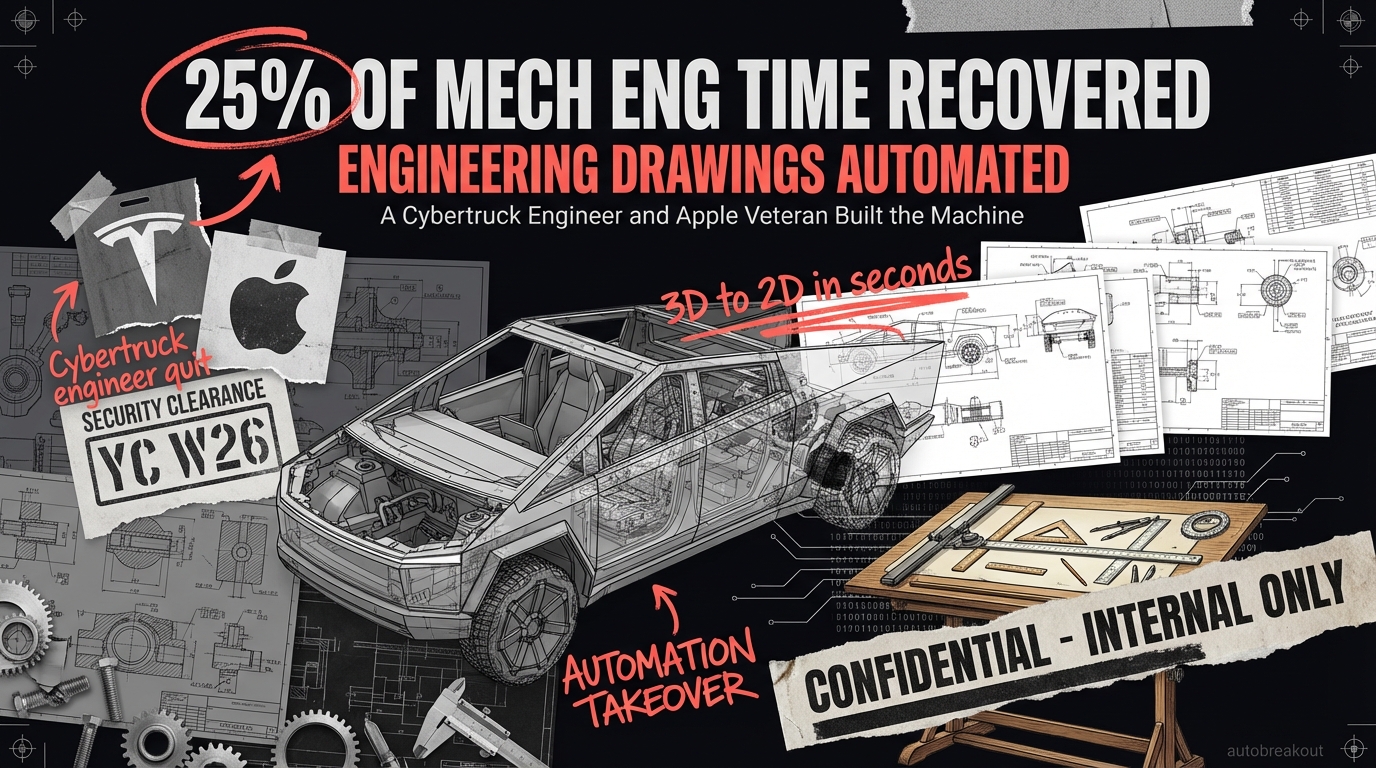
The Corporate Exit
Alex Rivero worked on the Cybertruck and Robotaxi at Tesla, then moved to Apple to work on the iPhone 17 lineup. Louis Liu built the planning platform that powers Tesla's global Supercharger network and Robotaxi deployment.
Both are mechanical engineers. Both lived inside the pain. And the pain is this: after you design something in 3D CAD, you still need to manually create 2D engineering drawings with proper GD&T annotations before manufacturing can begin. That step takes mechanical engineers over 25% of their total working time.
They quit to build REV1.
What REV1 Actually Does
REV1 converts 3D CAD models into manufacturing-ready 2D engineering drawings automatically. Proper views, proper dimensioning, proper GD&T annotations - the kind that follows 300+ pages of ASME standards.
What used to take hours now takes minutes.
Why Mechanical Engineers Should Pay Attention
Every physical product that gets manufactured needs engineering drawings. Every aerospace part, every automotive component, every medical device, every consumer gadget. The GD&T standard alone spans 300+ pages of rules that every drawing must follow.
This is rules-based work applied to geometric data. Exactly the kind of task AI was built to automate.
The engineers who worked on the Cybertruck and the iPhone decided that the drawing step - the tedious, hours-long translation from 3D model to 2D manufacturing spec - should take minutes. They built REV1 to make it happen.
The Breakout Pattern
Tesla and Apple are where the best hardware engineers go. When they leave to automate their own workflow, they're not guessing about the problem. They lived it every day. They know exactly which 25% of engineering time is recoverable.
That's the breakout.
Your domain expertise is the moat.
Explore 50 startup ideas for engineers who refuse to compete for shrinking jobs.
Browse 50 Ideas